

The Korean Alphabet - Hangul
An introduction to reading Hangul and understanding the letters of the Korean alphabet.
Introduction
Section titled “Introduction”Learning to read Hangul does not take long. Hangul has 24 basic letters: 14 consonants and 10 vowels. It also has 16 compound consonants and vowels, which we will cover later.
Hangul is made up of consonants, such as ㄱ (g) and ㅁ (m), and vowels, such as ㅏ (a) and ㅜ (u). The letters are grouped into syllable blocks. Each written block contains at least one consonant and one vowel.
The consonant ㅇ has no sound when it fills the initial position. For example, ㅇ and ㅏ (a) combine to create 아 (a).
This allows us to create sounds such as:
| ㅏ | ㅜ | |
|---|---|---|
| ㅇ | 아 (a) | 우 (u) |
| ㄱ | 가 (ga) | 구 (gu) |
| ㅁ | 마 (ma) | 무 (mu) |
Basic Consonants
Section titled “Basic Consonants”The ten consonants introduced in this lesson are: ㄱ, ㄴ, ㄷ, ㄹ, ㅁ, ㅂ, ㅅ, ㅇ, ㅈ, ㅎ
ㄱ= g/kㄴ= nㄷ= d/tㄹ= r/lㅁ= mㅂ= b/pㅅ= sㅇ= silent initially; ng finallyㅈ= jㅎ= h
You will need to memorize these letters. You can practise them with this pre-made Hangul Anki deck.
These English sounds are only rough comparisons:
ㄱsounds like a mix between “g” and “k”.ㄴis similar to an “n” sound.ㄷsounds like a mix between “d” and “t”.ㄹcan sound like an “r” or “l”, depending on its position.ㅁis similar to an “m” sound.ㅂsounds like a mix between “b” and “p”.ㅅis similar to an “s” sound.ㅇis silent at the beginning of a syllable and represents an “ng” sound at the end.ㅈsounds closer to “j” than “ch”. The aspirated “ch” sound is represented byㅊ, which we will cover later.ㅎis similar to an “h” sound.
Reading and memorizing these letters can be difficult at first. It is normal to read very slowly as a beginner. You will become faster with practice.
The letter ㄹ can be difficult for Korean learners because it does not exactly match the English “r” or “l”. It is usually romanized as r before a vowel and l before a consonant or at the end of a word. This video explains the pronunciation, but do not worry about sounding perfect when you are starting out.
Basic Vowels
Section titled “Basic Vowels”Next, let’s focus on these six vowels: ㅏ, ㅓ, ㅗ, ㅜ, ㅡ, ㅣ
ㅏ= aㅓ= eo (sounds roughly like “uh”)ㅗ= oㅜ= uㅡ= euㅣ= i
Combined with ㄱ, they form: 가 (ga), 거 (geo), 고 (go), 구 (gu), 그 (geu), 기 (gi).
Combined with ㄷ, they form: 다 (da), 더 (deo), 도 (do), 두 (du), 드 (deu), 디 (di).
Building Syllable Blocks
Section titled “Building Syllable Blocks”Each written Korean syllable block contains at least one consonant and one vowel.
| ㄱ | ㄴ | ㄷ | ㄹ | ㅁ | ㅂ | ㅅ | ㅇ | ㅈ | ㅎ | |
|---|---|---|---|---|---|---|---|---|---|---|
| ㅏ | 가 | 나 | 다 | 라 | 마 | 바 | 사 | 아 | 자 | 하 |
| ㅓ | 거 | 너 | 더 | 러 | 머 | 버 | 서 | 어 | 저 | 허 |
| ㅗ | 고 | 노 | 도 | 로 | 모 | 보 | 소 | 오 | 조 | 호 |
| ㅜ | 구 | 누 | 두 | 루 | 무 | 부 | 수 | 우 | 주 | 후 |
| ㅡ | 그 | 느 | 드 | 르 | 므 | 브 | 스 | 으 | 즈 | 흐 |
| ㅣ | 기 | 니 | 디 | 리 | 미 | 비 | 시 | 이 | 지 | 히 |
Basic consonant-vowel combinations with romanization:
| ㄱ | ㄴ | ㄷ | ㄹ | ㅁ | ㅂ | ㅅ | ㅇ | ㅈ | ㅎ | |
|---|---|---|---|---|---|---|---|---|---|---|
| ㅏ | 가 (ga) | 나 (na) | 다 (da) | 라 (ra) | 마 (ma) | 바 (ba) | 사 (sa) | 아 (a) | 자 (ja) | 하 (ha) |
| ㅓ | 거 (geo) | 너 (neo) | 더 (deo) | 러 (reo) | 머 (meo) | 버 (beo) | 서 (seo) | 어 (eo) | 저 (jeo) | 허 (heo) |
| ㅗ | 고 (go) | 노 (no) | 도 (do) | 로 (ro) | 모 (mo) | 보 (bo) | 소 (so) | 오 (o) | 조 (jo) | 호 (ho) |
| ㅜ | 구 (gu) | 누 (nu) | 두 (du) | 루 (ru) | 무 (mu) | 부 (bu) | 수 (su) | 우 (u) | 주 (ju) | 후 (hu) |
| ㅡ | 그 (geu) | 느 (neu) | 드 (deu) | 르 (reu) | 므 (meu) | 브 (beu) | 스 (seu) | 으 (eu) | 즈 (jeu) | 흐 (heu) |
| ㅣ | 기 (gi) | 니 (ni) | 디 (di) | 리 (ri) | 미 (mi) | 비 (bi) | 시 (si) | 이 (i) | 지 (ji) | 히 (hi) |
Pronunciation note: 시 is romanized as si, but its pronunciation is closer to the English word “she”.
Blocks with one consonant and one vowel use one of two layouts: side by side or top to bottom.
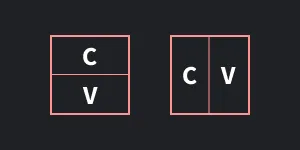
In the image, C means consonant and V means vowel.
Vowels with a vertical main stroke, such as ㅏ, ㅓ, and ㅣ, are placed to the right of the initial consonant. Vowels with a horizontal main stroke, such as ㅗ, ㅜ, and ㅡ, are placed below it.
Words in Korean can look like this:
- 아기 (agi): baby
- 고기 (gogi): meat
- 가방 (gabang): backpack
- 사람 (saram): person
- 물 (mul): water
- 손가락 (songarak): finger
A syllable block can also include a final consonant. A consonant at the bottom of a syllable block is called 받침 (batchim).
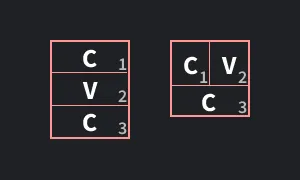
The numbers in the image show the reading order: initial consonant, vowel, and then final consonant.
In the word examples we can also see how the character ㅇ works. At the beginning of a syllable, ㅇ is silent. In 아기 (agi), it fills the initial position so that ㅏ can be written as part of a syllable block. At the end of a syllable, ㅇ represents an “ng” sound, as in 가방 (gabang).
In 응급 (eunggeup), the first ㅇ is silent and the second represents “ng”. The word means emergency.
That is almost everything you need to know about building these syllable blocks. Some blocks contain four letters, including two final consonants. We will cover their pronunciation in a later lesson.
In the next lesson, we will cover the remaining consonants and vowels. Luckily, they are similar to the ones you already know.
Sources & References
- Learn Hangul in 90 Minutes by BillyGo (YouTube video)
- Learn how to read Hangul by How to Study Korean (website)
- Learn Hangul 한글 (Korean Alphabet) by Miss Vicky (YouTube video)
Planned improvements to this page
- Short note on how to remember more easily (create fun images / references / stories)
- Audio